The Most Cost-Effective Way for Australian SMEs to Manage Financial Reporting
 Jul 10, 2026
Ask ten small business owners how they handle financial reporting and you'll probably get ten different answers — a shoebox of receipts and a New Year's Eve panic, a cheap software subscription nobody's actually reconciling properly, a local bookkeeper who comes in once a month, or a full accounting firm retainer that feels like a lot for what you're getting back.
Short answer: for most Australian SMEs, the most cost-effective way to manage financial reporting is a combination of proper cloud accounting software paired with outsourced bookkeeping and accounting services — not because it's the cheapest option on paper in every single case, but because it's the option that balances cost, accuracy, and time saved most reliably as a business grows.
Let's actually break down why, because "cost-effective" gets thrown around a lot without anyone defining what it means.
The Real Cost of Financial Reporting — DIY vs Local Hire vs Outsourced
Here's where most comparisons go wrong: they only count the cash cost, ignoring time and error risk. All three matter, and looking at them separately tells a clearer story than any single price tag.
DIY software only. Lowest direct cash cost by far, but it comes with the highest time cost — hours every month spent on data entry, categorisation, and reconciliation the owner usually isn't trained for. Error risk tends to run high too, since there's no second set of eyes checking the work.
Local bookkeeper, part-time. A meaningful step up in cash cost, but time cost drops substantially since someone else is handling the day-to-day. Error risk moderates, though it still depends heavily on one person getting things right consistently.
Local accounting firm, full retainer. Generally, the highest cash cost of the options here, with time cost and error risk both low — assuming the retainer covers proper reconciliation and review, not just annual compliance.
Outsourced accounting services. Cash cost typically sits well below a local retainer for equivalent scope, time cost stays low since the work is fully handled, and error risk tends to be low too, thanks to the multi-layer review processes built into how outsourced teams operate at scale.
DIY looks cheapest on the cash line and is often the most expensive option once you actually value the owner's time — and errors caught late (or not at all) tend to cost more than the software subscription ever saved.
What "Cost-Effective" Actually Means (Not Just Cheapest)
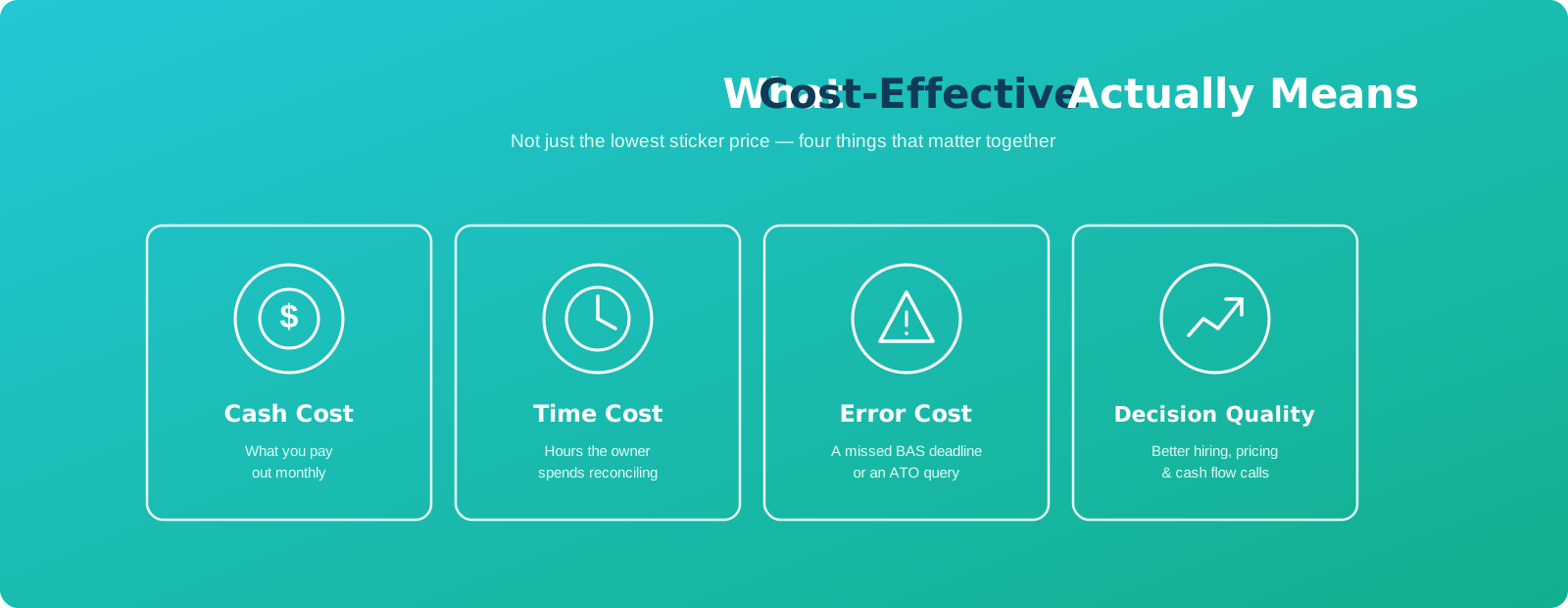
Cheapest and cost-effective aren't the same thing, and conflating them is how businesses end up worse off while thinking they've saved money.
A genuinely cost-effective approach accounts for:
- The direct cash cost — obviously, but it's only one part of the equation
- Time cost — what else could the owner be doing with those hours instead of reconciling transactions at 10pm
- Error cost — a missed BAS deadline, an incorrectly claimed GST credit, or a reporting mistake that leads to an ATO query all cost real money, sometimes far more than a proper service would have
- Decision quality — accurate, timely reports mean better decisions on hiring, pricing, and cash flow, which has a financial impact that's real but harder to put a single number on
A cheap DIY setup that leads to a missed deduction, or a BAS penalty because a deadline slipped through, isn't actually the cheap option once you add it all up. This is the exact reframe worth keeping in mind through the rest of this comparison.
Monthly Financial Reporting — What SMEs Actually Need
Before deciding how to manage reporting, it helps to know what "proper" reporting actually includes, since a lot of businesses are getting less than they think from whatever setup they currently have.
Profit & Loss statement. Revenue, costs, and the margin between them — reviewed monthly, not just at tax time, so trends show up while there's still time to act on them.
Balance sheet. What the business owns and owes at a point in time — assets, liabilities, equity. Often the most neglected report for small businesses, and one of the most useful for understanding actual financial health beyond just "is there cash in the account."
Cash flow statement. Distinct from the P&L, since profit on paper and cash in the bank frequently don't match up, especially for businesses with slower-paying clients or seasonal cycles.
KPI dashboard. Metrics beyond the standard three statements — gross margin trend, average payment time, customer acquisition cost, whatever actually matters for the specific business.
Most DIY setups produce, at best, a rough P&L. Full outsourced accounting services typically deliver all four as a matter of course, which is a meaningful part of where the value sits — not just the bookkeeping itself.
How Outsourcing Reduces Reporting Costs Without Reducing Quality
The mechanics here are worth spelling out plainly, since "it's cheaper" alone doesn't explain how.
Predictable pricing model. Rather than hourly billing that can quietly balloon, most outsourced accounting services run on a predictable flat arrangement, making budgeting straightforward and removing the temptation to skip a "non-essential" report to save money.
Software costs bundled in. Your Xero or MYOB subscription is usually managed and reconciled as part of the service, rather than billed separately on top of a bookkeeper's time.
Labour cost differential. As covered in plenty of outsourcing comparisons, the same qualified work simply costs meaningfully less when delivered by a Chartered Accountant or CPA based in India than an equivalent local hire — not because the work is lesser, but because of the underlying cost-of-living and wage differences between countries.
Built-in review layers. Outsourced teams processing high volumes of similar work across many clients tend to catch errors earlier, reducing the downstream cost of mistakes that a stretched local setup might miss.

When DIY Software Alone Is Still the Right Call
It's worth being honest here rather than pretending everyone needs to outsource immediately.
If you're a sole trader or very early-stage business with simple, low-volume transactions, a decent cloud accounting package used properly might genuinely be enough for now. The tipping point tends to arrive when:
- Transaction volume climbs past what you can reasonably review yourself each month
- You're spending real hours on bookkeeping that could go toward actually growing the business
- You're making bigger financial decisions (hiring, expansion, funding) and need reports you can actually trust
- BAS and compliance work starts feeling rushed or uncertain rather than routine
There's no shame in staying DIY a bit longer if your situation genuinely doesn't need more yet — the mistake is staying there out of habit long after it stopped being the cost-effective choice.
How to Transition From DIY or Local Bookkeeping to an Outsourced Model
If the tipping point above sounds familiar, the actual switch is more straightforward than most business owners expect.
1. Data migration. First thing that usually happens is your existing Xero or MYOB file gets a proper look-over, cleaned up wherever needed. Most historical categorisation has a bit of mess in it somewhere, so sorting that out tends to be the actual starting point, not an afterthought.
2. Handover period. A decent provider will want a few weeks of crossover, especially if you're coming off a local bookkeeper, just so nothing slips through the gap between old and new.
3. First-month expectations. Don't expect perfection on day one — the first month's really about getting up to speed. Understanding how your business runs, agreeing on when reports land, catching whatever historical issues turn up along the way.
4. Settling into a cadence. By month two or three, most businesses report the relationship feeling routine, with reporting arriving reliably and questions answered promptly.
Setting realistic expectations for this transition period matters. Providers who promise a completely seamless, zero-disruption switch are usually glossing over the genuine (if short) adjustment period every handover involves.
Does the Right Approach Change by Industry?
To a degree, yes — some industries have reporting quirks that make DIY software particularly risky, or make outsourced reporting particularly valuable.
Retail and e-commerce deal with high transaction volumes and inventory valuation, both of which get messy fast without proper reconciliation — this is often where DIY stops being viable earliest.
Trades and construction businesses often deal with progress claims, retention amounts, and project-based profitability, which basic accounting software handles poorly without proper setup.
Professional services (consultants, agencies) need to track utilisation and project margins closely — standard P&L reporting alone often hides which parts of the business are actually profitable.
Hospitality typically involves high transaction volumes and tighter margins, meaning small reporting errors compound quickly and get noticed even faster when cash is tight.
If your industry has quirks like these, it's a reasonable signal that a properly resourced outsourced accounting services provider will pay for itself faster than in a simpler, lower-volume business.
Scaling Reporting Needs as the Business Grows
What counts as "enough" reporting changes as revenue climbs, and it's worth planning for this rather than being caught out by it.
Early stage. A basic P&L reviewed quarterly might be genuinely sufficient, alongside simple cloud accounting software.
Growing SME. Monthly P&L, balance sheet, and cash flow become important, since decisions are getting bigger and gut feel starts running out of runway.
Established, multi-entity, or funding-seeking businesses. Full monthly reporting across all statements, plus KPI tracking and often board-ready reporting packs, becomes close to essential — this is also where outsourced accounting services tend to show the clearest cost advantage over building an equivalent in-house function.
Revisiting what level of reporting your business actually needs every year or so, rather than sticking with whatever setup you started with, is one of the simpler ways to avoid either overpaying for reporting you don't need yet, or under-reporting past the point where it's actually risky.
A Realistic Example
A Perth-based trades business had been running on DIY software for three years, with the owner doing bookkeeping most Sunday nights. Reports were rough, BAS preparation was often rushed, and a missed input tax credit was only caught by their accountant during an annual review — a year after it happened.
Moving to outsourced accounting services, all-in, including bookkeeping, BAS preparation, and monthly reporting, gave the owner a meaningful chunk of time back each month. Reports arrived by the 5th of each month rather than being pieced together under deadline pressure, and BAS preparation moved from consistently late to consistently ready a week early for their registered agent to lodge. Measured purely on cash cost, this wasn't the cheapest option available — but measured on time saved, errors avoided, and decision quality, it was clearly the more cost-effective one.
The Bottom Line
The most cost-effective way for Australian SMEs to manage financial reporting isn't necessarily the option with the lowest sticker price — it's the one that balances cash cost, time cost, and error risk sensibly for where the business actually is. For a growing number of SMEs, that balance points toward outsourced accounting services: proper reporting, qualified oversight, and meaningful cost savings compared to a local hire or full local retainer, without the hidden costs that come with stretching DIY software past the point it can reasonably handle.
The businesses that get this decision right tend to revisit it periodically rather than setting it once and forgetting about it — what was cost-effective at an earlier stage often isn't once the business has scaled up considerably, and being honest with yourself about which stage you're actually at is most of the battle.

Frequently Asked Questions
What is the cheapest way for a small business to manage financial reporting in Australia? DIY cloud accounting software has the lowest cash cost, but factoring in the owner's time and the risk of costly errors, it's often not the most cost-effective option once a business grows past a certain point.
Is outsourcing financial reporting to India cost-effective for a small business, or only larger companies? It works for both, though small businesses often see the clearest relative benefit, since they're avoiding the cost of a full local hire or an ongoing local accounting firm retainer they may not yet be able to justify.
What financial reports should an Australian SME be reviewing every month? At minimum, a Profit & Loss statement, balance sheet, and cash flow statement — ideally alongside a KPI dashboard tracking whatever metrics matter most for the specific business.
How do I know if I should switch from DIY accounting software to outsourced reporting? A few signs usually stack up together — transaction volume's climbing, you're burning real personal time on bookkeeping, the decisions you're making are getting bigger than what gut feel can safely handle, or BAS preparation is starting to feel like a scramble instead of routine.
Does cost-effective financial reporting mean lower quality? Not really, no. Where the savings actually come from is labour cost and overhead — not from skipping review steps or hiring less qualified people. If anything, outsourced setups often end up with more checks built in than one stretched local bookkeeper could realistically manage alone.