How to Seamlessly Transition Your Business to an Outsourced Payroll Processing Model
 Jun 15, 2026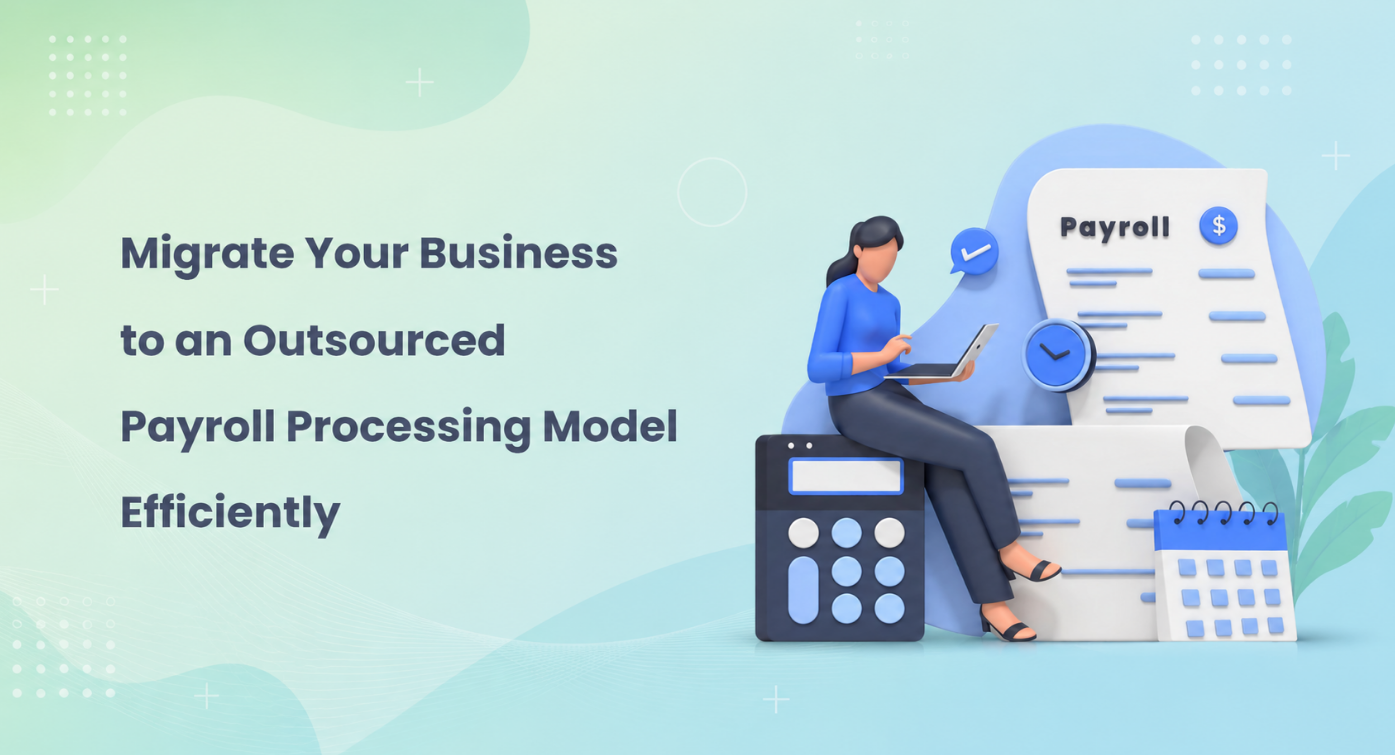
“The businesses winning at scale all made one smart move - they Outsourced Payroll”
At some point, almost every growing business hits the same wall. What started as a manageable in-house task - calculating wages, tracking leave, filing superannuation - quietly becomes one of the most time-consuming and risk-prone jobs in the building. That's usually the moment business owners start seriously exploring payroll outsourcing.
But making the switch isn't simply a matter of handing over a spreadsheet and walking away. Done poorly, it creates confusion, compliance gaps, and frustrated employees. Done well, it frees your team from one of the most administratively dense workflows in business operations. The difference comes down to how you manage the transition.
Step-by-Step: The Professional Payroll Onboarding Protocol
Step 1: Execute a Complete Internal Payroll and Award Audit
Before you bring any external partner into the picture, you need to know exactly what you're handing over. That means mapping every modern award, enterprise agreement, employment contract type, and custom pay structure currently running across your workforce.
This isn't just a housekeeping exercise. It's the foundation everything else is built on. If your employee master data contains errors - outdated classifications, incorrect pay rates, missing entitlements - those errors will simply migrate into the new system and become someone else's problem to untangle later. Establish a clean, verified baseline first, and the rest of the process becomes significantly smoother.
Step 2: Align Data Pipelines and Software Integration Hooks
Once your data is in order, the technical configuration begins. Your payroll service provider should be building and testing the synchronization layers that connect your time-and-attendance system, HR platform, and accounting software to their processing engine.
The goal here is clean, automated data flow. If your team is still manually reformatting exports or fixing column headers every pay cycle, that's a sign the integration hasn't been set up properly. Good payroll processing services will handle this configuration work as part of onboarding - not leave it as a workaround for your team to manage indefinitely.
Step 3: Run Concurrent Parallel Payroll Processing Cycles
This is the step most businesses are tempted to skip, and it's the one that matters most. Before you decommission your old system, run a minimum of two complete payroll cycles simultaneously on both platforms - your existing internal setup and the new outsourced engine - and reconcile every single line.
That means checking gross pay, tax withholdings, superannuation calculations, leave accruals, and net payments to the cent. If there's a discrepancy, you want to find it during parallel testing, not after your employees have been paid incorrectly. There are no shortcuts here. This parallel phase is what separates a clean transition from a costly rollback.
Step 4: Cut Over to the Fully Managed Outsourced Engine
Once your parallel runs reconcile perfectly, you're ready to go live. Execute the cutover cleanly - communicate with your employees about any changes to their payslip format or bank processing timelines, and formally archive the old infrastructure rather than leaving it running in the background.
A well-managed go-live should feel unremarkable to your workforce. That's the point. The complexity should be invisible to them.
3 Immediate Signs of a Deficient Payroll Transition
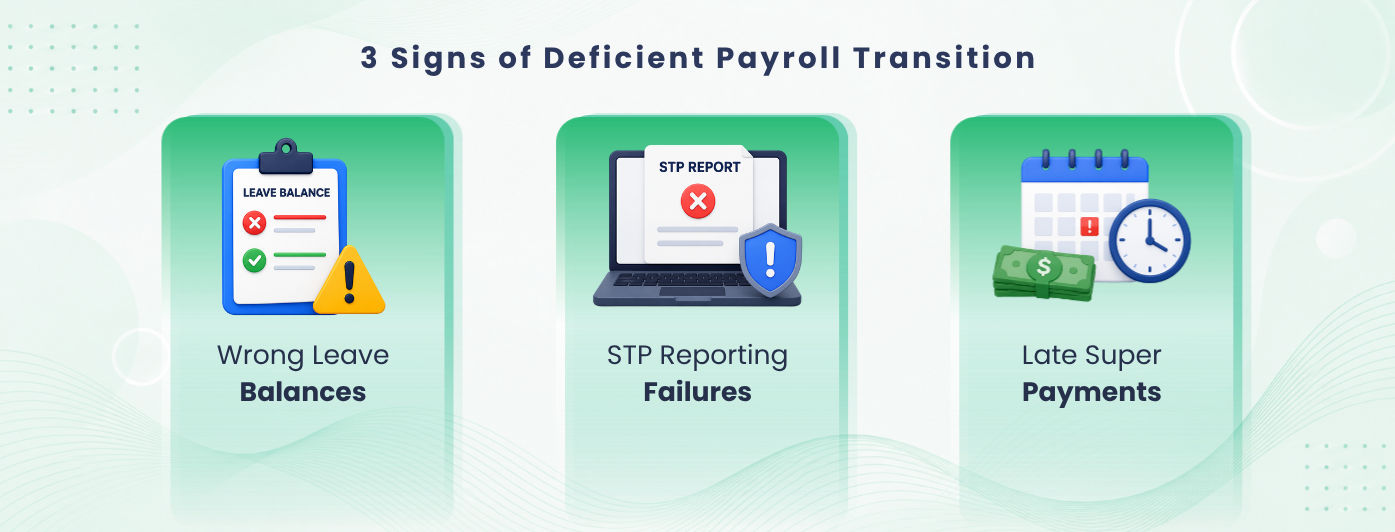
Even with careful planning, problems can surface in the early weeks post-transition. Here are three warning signs to watch for:
- Discrepancies in Year-to-Date Leave Accrual Balances
If you discover that balances for annual leave or personal leave are wrong as reported by employees after the switchover, you need to address it immediately. Poor data migration often leads to YTD leave accrual errors - historical balances are either not migrated correctly or calculated using a different methodology. If left uncorrected, these discrepancies provide legal exposure under the Fair Work Act and quickly erode employee trust.
- Failure of Single Touch Payroll Submissions to Report Correctly to the ATO
Single Touch Payroll (STP) is non-negotiable in Australia. Every pay event needs to be reported to the ATO accurately and on time. If your new system is submitting incorrect year-to-date figures, failing to report at all, or generating error notifications from the ATO, that's a configuration problem that needs immediate attention from your provider. Delays or inaccuracies here can trigger compliance reviews and penalties you simply don't want.
- Delays in Processing Superannuation Clearing House Distributions
Superannuation contributions must be paid by the quarterly deadline - currently 28 days after the end of each quarter. If your outsourced payroll provider is experiencing delays in pushing contributions through to the clearing house, or if fund allocations are landing incorrectly, that's both a compliance risk and a sign that the payment workflows weren't properly configured during setup. Don't wait for the ATO to flag it. Review your super payment confirmations after your first few cycles.
Future-Proof Your Corporate Compliance Engine
The businesses that scale successfully - whether locally or across international markets - tend to share one common trait. They're disciplined about offloading high-complexity, low-strategic-value workflows to specialists who do nothing else.
Payroll is the clearest example of this principle in practice. It's not a function that benefits from being kept in-house for the sake of it. Compliance obligations in Australia continue to grow in complexity - from evolving award interpretations to STP Phase 2 reporting requirements to superannuation guarantee increases. Keeping pace with all of it while also running a business is, for most operators, an unnecessary burden.
The right payroll outsourcing solution doesn't just process your pays. It becomes a compliance buffer between your business and an increasingly demanding regulatory environment, while giving your internal team the bandwidth to focus on work that actually moves the needle.
If your current payroll setup is creating friction, absorbing too much of your team's time, or leaving you uncertain about compliance, that's your signal. The transition process is manageable when it's structured correctly - and the operational clarity on the other side is worth every step of it.